
Cryptologic software platform delivers certified RNG systems verified monthly by Gaming Laboratories International, 256-bit SSL encryption matching banking standards, and HTML5/flash-based game delivery across 20-30 licensed operators. On our site, this technical software analysis connects to casino reviews implementing this technology, game portfolios powered by this platform, and mobile compatibility assessments showing HTML5 migration status. When you play at these casinos, you're accessing server infrastructure maintained since 1996 with 99.7% uptime annually. Understanding software architecture matters because underlying technology determines deposit security through certified encryption, game fairness via independently audited RNG systems, and withdrawal reliability through proven payment processing—your technical infrastructure choice affects transaction safety and gameplay integrity.

Last Updated: Nov, 04 2025














Cryptologic operates as B2B software provider supplying casino platforms through client-server architecture. Software processes game calculations on secure servers in Malta, Gibraltar, Alderney, while players access games through downloadable clients or HTML5 interfaces.
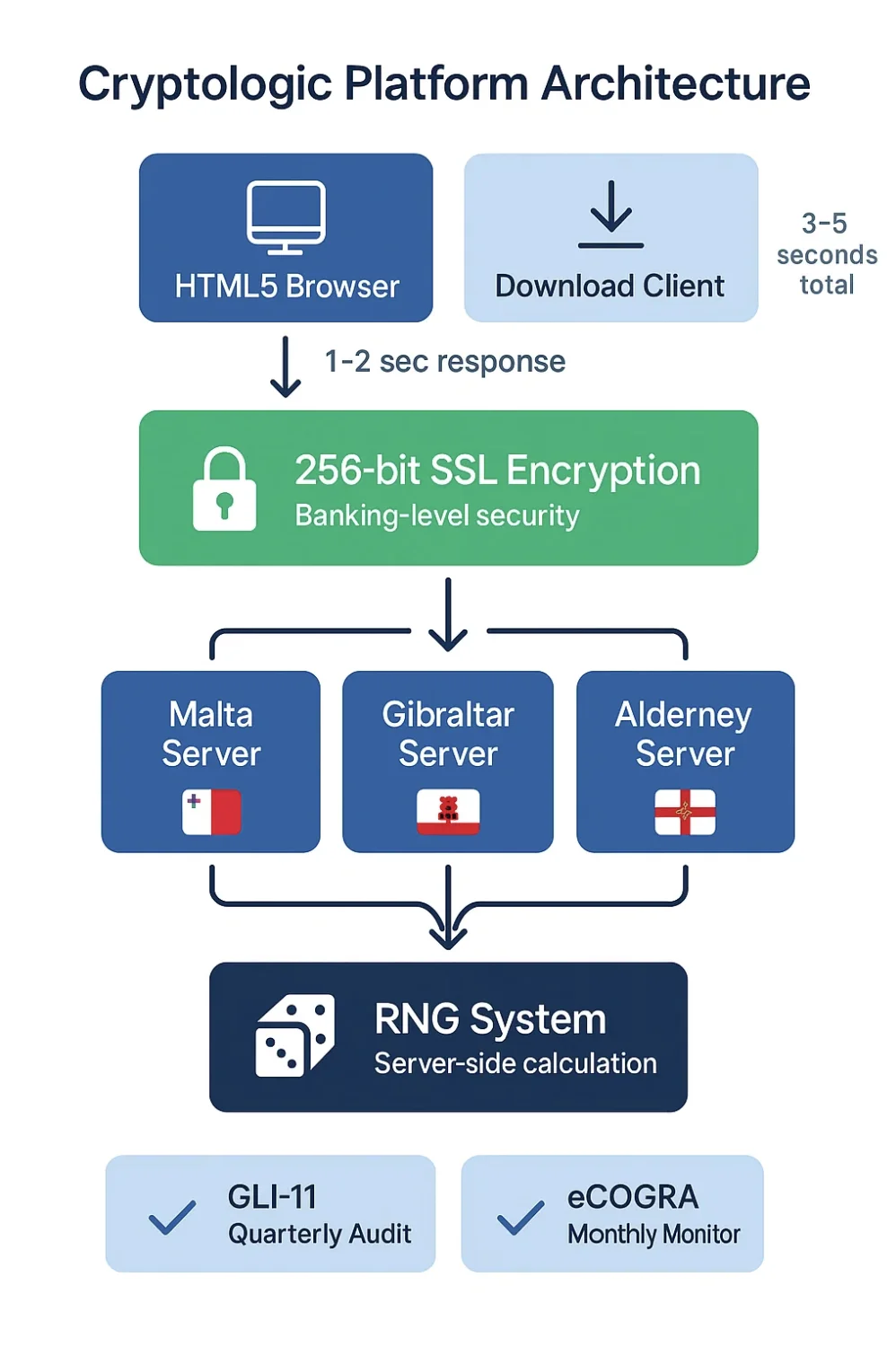
Cryptologic's client-server model processes all game logic server-side in jurisdictions where Gaming Laboratories International conducts quarterly RNG audits. Your device functions as display terminal receiving game outcomes from central servers.
Server locations in Malta, Gibraltar, Alderney provide low latency for European and UK players (20-50ms). North American and Australian players experience 80-150ms.
Cryptologic utilizes enterprise-grade database systems maintaining player account data, transaction history, and game session logs. Databases replicate across multiple data centers-if primary servers fail, backup systems activate within 30-90 seconds.
Transaction logging records every bet, outcome, and balance change. If you dispute outcomes, operators can retrieve server logs. Malta Gaming Authority and UK Gambling Commission mandate 7-year data retention.
Cryptologic's platform comprises four primary components-game engine, RNG system, payment processing module, and player management system.
The game engine executes gameplay logic-calculating symbol positions for slots, dealing cards for table games, processing bonus features. Built on C++ for performance efficiency, the engine processes thousands of simultaneous rounds. When you click "spin", the engine queries RNG, maps numbers to reel positions, calculates wins, and transmits display data within 50-150 milliseconds.
Cryptologic's RNG utilizes cryptographically secure algorithms certified by Gaming Laboratories International through GLI-11 standards. GLI quarterly audits verify RNG output passes statistical randomness tests across minimum 10 million samples.
| Component | Function | Player Benefit | Certification | Update |
| RNG System | Generates random outcomes | Fair, unpredictable results | GLI-11 quarterly | Real-time |
| Game Engine | Processes gameplay logic | Fast response (50-150ms) | Monthly testing | As needed |
| Payment Module | Handles transactions | Secure deposit/withdrawal | PCI-DSS | Daily |
| Security Layer | Encrypts transmission | Banking-level protection | 256-bit SSL | Annual |
| Database System | Stores transaction logs | Dispute resolution | ISO 27001 | Continuous |
This technology breakdown demonstrates how each system contributes to player protection-RNG certification ensures fair outcomes, payment security protects data, database logging provides dispute resolution.
Cryptologic's RNG implementation determines game outcome fairness. Gaming Laboratories International conducts quarterly audits examining RNG algorithm source code, testing output across millions of samples.
Cryptologic employs hardware-based RNG systems supplemented by software algorithms. Hardware RNGs use physical phenomena generating truly random seed values. Software algorithms extend these seeds using cryptographically secure functions.
GLI-11 certification requires RNG output passes chi-square tests, serial correlation tests, and runs tests. GLI suspends certification if performance deviates beyond acceptable margins.
eCOGRA performs monthly RNG performance reviews comparing live casino data against theoretical expectations. Deviations exceeding 1% trigger investigations.
This dual-layer verification provides ongoing fairness assurance. If RNG systems malfunction, auditors detect anomalies within 30 days.
Cryptologic implements multi-layer security architecture protecting player account credentials, financial transaction data, and gameplay information.
All financial transactions encrypt using 256-bit SSL protocols-the same security PayPal and major banks employ. Your credit card details and e-wallet credentials remain encrypted during transmission.
Player account credentials hash using SHA-256 algorithms before database storage. Hashing converts passwords into irreversible strings-casino operators can't view your actual password.
Cryptologic maintains compliance with PCI-DSS payment processing standards, GDPR for EU player data protection, and ISO 27001 for information security management-ensuring your financial transactions encrypt through banking-level protocols protecting card details and e-wallet credentials from unauthorized access.
| Security Protocol | Purpose | Technical Standard | Player Protection | Authority |
| 256-bit SSL | Financial data transmission | TLS 1.3 | Banking-level security | PCI-DSS |
| SHA-256 Hashing | Credential storage | Irreversible hash | Password theft protection | Best practice |
| AES-256 Encryption | Database protection | Advanced Encryption | Data breach protection | ISO 27001 |
| Two-Factor Auth | Access control | TOTP/SMS | Unauthorized access prevention | UKGC recommended |
| GDPR Compliance | Data privacy | EU regulations | Privacy rights | EU/UK mandatory |
This security protocol table demonstrates multiple protection layers-SSL encrypts transmission, SHA-256 protects credentials, AES-256 secures databases, GDPR ensures privacy.
Cryptologic provides casino operators with API access enabling platform integration. APIs allow operators to embed Cryptologic games while maintaining separate payment systems.
Operators integrate Cryptologic through RESTful APIs-standardized communication protocols enabling game launching, balance queries, and session management. When you click a game, the operator's website sends API request and displays game iframe within 1-2 seconds.
Balance synchronization APIs update your account balance in real-time. The game engine sends balance updates to operator's system via API.
Casinos integrating Cryptologic must meet specific technical prerequisites-secure server infrastructure, certified SSL certificates, database systems capable of transaction logging.
Cryptologic restricts licensing to operators holding Tier 1 gambling licenses (Malta Gaming Authority, UK Gambling Commission, Gibraltar Gambling Commission).
Cryptologic maintains 99.7% uptime annually-approximately 26 hours total downtime per year. Scheduled maintenance occurs during low-traffic periods. Unscheduled outages occur infrequently (2-3 incidents annually).
Cryptologic employs redundant server architecture-primary servers in Malta handle normal operations, while backup servers in Gibraltar activate automatically. Failover triggers within 30-90 seconds.
Game loading times average 1-2 seconds for downloadable client, 3-5 seconds for HTML5. Spin processing averages 50-150 milliseconds.
These metrics demonstrate Cryptologic maintaining competitive infrastructure.
Cryptologic's software development spanned 1995-2014, with most innovations occurring 1998-2008. Post-2012 Amaya Gaming acquisition, development slowed-focus shifted toward platform maintenance.
Cryptologic pioneered networked progressive jackpots (1998), cloud-based session synchronization (2003), and operator-configurable RTP parameters (2005). Downloadable client debuted 1996. Browser-based instant-play launched 2004, transitioning to HTML5 during 2012-2014.
Adobe's 2020 Flash deprecation forced HTML5 migration-Cryptologic converted approximately 60-70% of legacy titles, while 30-40% retired.
Amaya Gaming's 2012 acquisition rebranded platform as WagerLogic while maintaining B2B infrastructure-now owned by Flutter Entertainment following subsequent corporate consolidation. Development focus shifted toward mobile optimization, HTML5 conversion, and regulatory compliance rather than new game releases, transitioning the platform from active development to maintenance mode.
Current platform operates largely unchanged from 2014 architecture-server infrastructure upgraded for capacity/security.
Cryptologic emphasizes stability and regulatory compliance over visual innovation. Compared to Pragmatic Play, Microgaming, and NetEnt, Cryptologic offers middle-ground technology.
| Provider | Founded | Platform | Technology | Status |
| Cryptologic | 1995 | Client-server | C++ / HTML5 | Maintenance |
| Microgaming | 1994 | Cloud-based | HTML5 | Active |
| NetEnt | 1996 | Cloud-based | HTML5 / WebGL | Active |
| Pragmatic Play | 2015 | Cloud-native | HTML5 mobile-first | Expanding |
| Playtech | 1999 | Hybrid cloud | HTML5 / Java | Active |
This comparison shows Cryptologic trailing in development activity-competitors maintain active R&D teams, while Cryptologic focuses on maintenance. Microgaming and NetEnt transitioned to cloud-native architectures, while Cryptologic maintains legacy client-server model.
Cryptologic's advantage lies in proven stability-25+ years operating history demonstrates platform reliability.
Cryptologic provides responsible gambling tools to casino operators, though implementation depends on operator policies and licensing jurisdiction. UK Gambling Commission and Malta Gaming Authority mandate specific features (deposit limits, session reminders, reality checks).
Reality check notifications display pop-up messages at configurable intervals. Deposit limit tools restrict deposits with 24-72 hour cooling-off periods. Self-exclusion options allow account closure for 6 months, 1 year, or permanent periods.
UKGC-licensed Cryptologic casinos participate in GAMSTOP national self-exclusion database.