
Cryptologic company history chronicles 1996-2026 operations as pioneering online gambling software provider, including founding by Rivkin brothers, 1996-2012 game development (300+ titles), 2012 Amaya Gaming acquisition, and current Flutter Entertainment ownership. On our site, this historical analysis connects to provider reviews explaining current technology status, casino rankings featuring operators maintaining legacy portfolios, and software comparisons contextualizing evolution versus modern providers. When searching for company history, you're seeking background explaining current operations—why games remain available despite acquisition, which companies own the assets, and whether historical reputation translates to current reliability. Understanding historical trajectory matters because company evolution from market pioneer to legacy provider explains current game availability limitations (no post-2012 releases), operator partnerships declining from 50-80 (peak) to 20-30 (current), and why historical reputation for fairness and security remains relevant despite development cessation—your historical context enables realistic expectations for casino experiences.

Last Updated: Nov, 04 2025












Cryptologic Limited founded in 1996 by Andrew and Mark Rivkin in Toronto, Canada. The company developed encryption protocols enabling secure transactions and certified random number generation ensuring fair outcomes.
Andrew Rivkin (CEO) and Mark Rivkin (CTO) addressed payment processing security, game verification, and regulatory compliance. InterCasino launched in 1996 as Cryptologic's first partner, becoming one of the world's first legal real money online casinos. 1996-2000 period saw Cryptologic partnering with 10-15 operators through turnkey software solutions.
| Time Period | Key Milestones | Casino Partners | Game Portfolio | Player Impact |
| 1996-1998 | Company founding, InterCasino launch, encryption development | 1-3 operators | 20-30 basic slots, table games | First secure online gambling |
| 1998-2000 | Payment processing expansion, RNG certification | 10-15 operators | 50-80 games | Enhanced payment security |
| 2000-2004 | IPO, progressive jackpots, licensing expansion | 30-50 operators | 150-200 games | Progressive jackpot access |
| 2004-2008 | Market leadership, branded games, mobile development | 50-80 operators | 250-300 games | Branded slot availability |
| 2008-2012 | Regulatory challenges, market consolidation | 40-60 operators | 300+ games (static) | Stable game access |
| 2012-2026 | Amaya acquisition, Stars Group integration, Flutter ownership | 20-30 operators | 300+ legacy games | Legacy portfolio access |
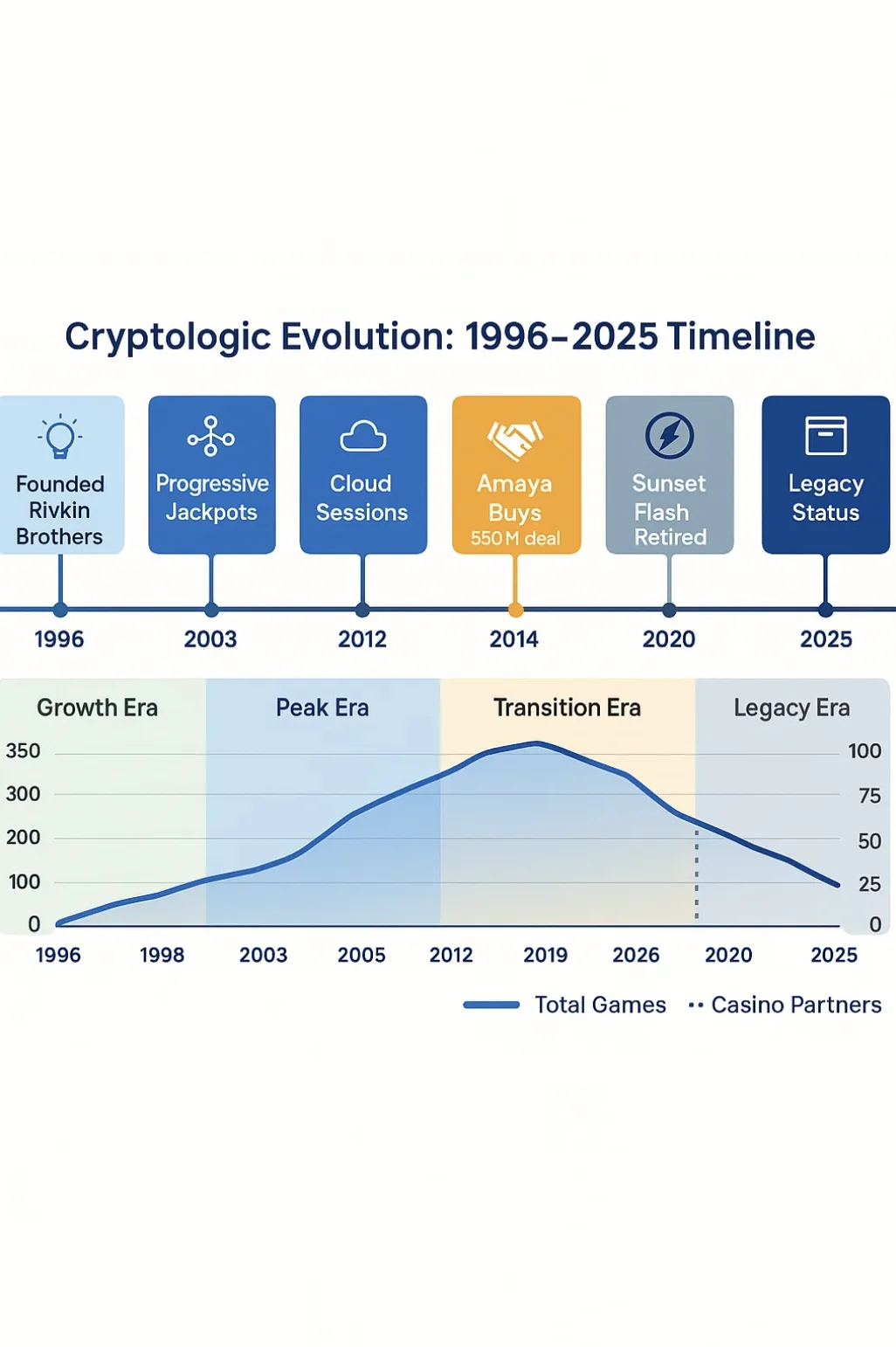
This timeline demonstrates Cryptologic's trajectory: rapid expansion 1996-2008, consolidation 2008-2012, legacy status 2012-2026. Partnerships peaked at 50-80 operators, declining to 20-30 current operators.
2000-2008 represented Cryptologic's peak innovation. Public listing in 2000 enabled accelerated development and progressive jackpot networks.
Cryptologic went public in 2000. Revenue grew from $10-15 million (2000) to $150-200 million peak (2007-2008). Progressive jackpot network pooled wagers from 30-50 casinos accumulating jackpots exceeding $1-5 million. Notable titles: Millionaires Club, King Cashalot. Largest jackpot: approximately $6-8 million. Cryptologic also secured Marvel licensing developing branded slots.
2008-2012 period saw intensifying competition from NetEnt and Microgaming. Regulatory changes required operational adjustments.
US UIGEA 2006 restricted payment processing. Cryptologic withdrew from US market, reducing revenue 20-30%. UK Gambling Act 2005 required UKGC licenses. Cryptologic obtained licenses in Malta, Gibraltar, and Alderney, implementing responsible gambling tools.
NetEnt invested in HTML5 mobile development and modern graphics. Cryptologic maintained flash-based platform disadvantaging mobile compatibility. HTML5 migration 2010-2012 lagged competitors.
Amaya Gaming acquired Cryptologic in 2012 for $35-40 million—below Cryptologic's $150-200 million peak valuation. Acquisition motivations: licensing portfolio, game library (300+ titles), and casino relationships.
Reduced valuation reflected declining revenue ($80-100 million annually), intensifying competition, and technological debt. Acquisition uncertainty disrupted casino relationships. Some operators switched to NetEnt or Microgaming. Remaining casinos (40-50 operators 2012) maintained partnerships. Amaya integration prioritized poker and sports betting over casino games.
Post-acquisition 2012-2026 saw Cryptologic transitioning to legacy maintenance. Amaya rebranded to The Stars Group (2017), later acquired by Flutter Entertainment (2020). Flutter currently owns Cryptologic intellectual property.
New game development ceased 2012-2014. Portfolio entered maintenance mode: games available, no new titles. Partnerships declined: 40-50 operators (2012) to 20-30 operators (2026). See our Top Cryptologic Online Casinos for current operators.
Flutter Entertainment (NYSE/LSE) currently owns Cryptologic assets. Flutter operates PokerStars, FanDuel, Betfair, Paddy Power. Cryptologic represents minor asset providing financial stability.
Andrew Rivkin (CEO) established casino partnerships, navigated regulatory environments, and secured public listing enabling company growth. Mark Rivkin (CTO) led technology development: encryption protocols, RNG certification, and platform architecture. The Rivkin brothers' complementary skills—business acumen and technical expertise—enabled Cryptologic's balanced growth strategy addressing both operational and technological challenges. Rivkin leadership tenure 1996-2010 established Cryptologic's technical reputation and regulatory compliance culture. Both brothers departed pre-acquisition leaving professional management. Amaya integration 2012-2014 dissolved independent management structure. Current Flutter structure treats Cryptologic as legacy asset without dedicated leadership.
InterCasino (launched 1996) remained Cryptologic's flagship partner through 2010s, serving as showcase demonstrating platform capabilities. Other major partnerships included William Hill Casino (UK market leader) and Casino.com (international brand). Partnership benefits for casino operators: turnkey software solution reducing technical development costs, progressive jackpot network access attracting players seeking large prizes, and Cryptologic's licensing portfolio facilitating regulatory approval processes in multiple jurisdictions. These benefits enabled rapid market entry for operators lacking in-house development resources. Current partnerships (2026): approximately 20-30 operators maintaining Cryptologic games primarily for established player bases. Most operators supplement Cryptologic portfolios with multiple modern providers ensuring game variety.
These dynamics demonstrate Cryptologic's evolution from dominant provider to supplementary component.
Cryptologic portfolio evolved from basic slots (1996-2000) to 300+ titles (2012). For detailed analysis, see our Cryptologic Casino Games guide.
1996-2000 focused on blackjack, roulette, video poker, basic slots. 2000-2008 accelerated: 5-reel video slots, licensed branded games, progressive jackpots. Notable titles: Millionaires Club, Marvel-themed slots (Spider-Man, X-Men, Iron Man). Current experience: legacy titles offer classic gameplay without modern features.
| Game Category | Development Era | Notable Examples | Player Appeal | Current Availability |
| Progressive Jackpot Slots | 2000-2012 | Millionaires Club, King Cashalot | Multi-million dollar prizes | 20-30 casinos |
| Marvel Branded Slots | 2005-2012 | Spider-Man, Iron Man, X-Men | Licensed property recognition | Limited (licensing ended) |
| Classic 3-Reel Slots | 1996-2008 | Fruit Fiesta, Reel Classic | Simple gameplay | 20-30 casinos |
| 5-Reel Video Slots | 2000-2012 | Treasure Nile, Poker Ride | Bonus features | 20-30 casinos |
| Table Games | 1996-2012 | Blackjack variants, Roulette | Traditional casino games | 20-30 casinos |
| Video Poker | 1996-2012 | Jacks or Better, Deuces Wild | Strategic gameplay | 20-30 casinos |
This comparison demonstrates Cryptologic's diverse portfolio. Current availability: 20-30 operators. Marvel licensing ended following Disney's 2009 acquisition.
Cryptologic pioneered secure payment processing, certified RNG implementation, and progressive jackpot networks.
1996 encryption protocols addressed online gambling's primary barrier: payment security. Secure credit card processing enabled confident deposits. Modern payment security (256-bit SSL, PCI-DSS) builds upon Cryptologic foundations.
Proactive licensing pursuit established precedent: legitimate gambling requires regulatory approval and transparent operations. Current tier-1 licensing (UKGC, MGA) reflects standards Cryptologic normalized.
Cryptologic's success encouraged competitor investment. Competitive pressure drove innovation benefiting players through expanding variety, improving graphics, and developing mobile platforms.
Cryptologic's trajectory provides instructive lessons. First-mover advantages provide temporary positions requiring continuous innovation. Technological debt creates competitive disadvantages.
Acquisition impacts: Integration redirected resources from casino games. Players encounter static portfolios reflecting strategic priorities. Modern selection requires assessing provider development trajectories.
Brand persistence: Despite minimal development 2012-2026, games remain available at 20-30 casinos. Historical reputation and proven fairness create ongoing value demonstrating lasting technical excellence.
Understanding Cryptologic history enables informed casino selection. Players recognize proven fairness, static portfolios, and licensing credibility. Historical context explains why casinos maintain Cryptologic partnerships.
Casino selection: Multi-provider casinos supplementing Cryptologic with modern providers provide optimal balance. See our Cryptologic Casino Review for analysis.
Responsible gambling applies regardless of provider history. Set personal limits, separate gambling funds from living expenses, view gambling as entertainment. Organizations like GamCare, Gamblers Anonymous, and National Council on Problem Gambling provide confidential support.